
How to Choose a Hair Brush for Your Hair Type
Most of us own one brush and ask it to do everything: detangle in the shower, smooth a blow-dry, tidy a ponytail, survive the bottom of a gym bag. It works well enough until it doesn't, and when it stops working the blame usually lands on the hair rather than the tool. Picking a hair brush for your hair type is one of the cheapest changes you can make to a routine, and it quietly decides how much breakage you cause on an ordinary Tuesday morning.
This guide covers what genuinely differs between brushes, then matches those differences to fine, thick, curly and coily hair, and to the job you are asking the brush to do. It is about choosing the tool rather than using it. If you want technique, we have written that up separately and linked it at the end.
Why a hair brush for your hair type beats better technique
Technique matters, but it can only compensate so far. A brush with stiff, densely packed bristles will find every knot in fine hair and pull through it whether or not you are holding the section correctly. A brush with soft, widely spaced bristles will skate over the surface of thick hair and never reach the mid-lengths where the tangles actually sit.
The tool sets the ceiling. Get it right and careful brushing becomes the default rather than something you have to concentrate on. Most of the brush and comb options mentioned below sit in our tools and accessories collection if you would rather browse the full range.
The three things that actually differ between brushes
Marketing language around brushes is vague — "professional", "anti-frizz", "smoothing". Ignore it and look at three physical properties instead.
1. Bristle material. Natural boar bristle is fine, soft and slightly rough at a microscopic level, which is why it grips the cuticle and carries scalp oil down the strand. It is excellent on fine and medium hair and close to useless on dense, coarse hair — it simply cannot penetrate. Nylon and moulded synthetic bristles are stiffer, longer and better at getting through bulk. Mixed-bristle brushes combine the two: nylon pins to part the hair, boar to smooth what the pins have separated.
2. Bristle flexibility and spacing. This is the property that most affects breakage. Flexible bristles mounted on a soft pad give way when they meet resistance instead of dragging the hair through it. Widely spaced bristles let a knot sit in the gap rather than compressing it into a tighter knot. Dense, rigid bristles are for smoothing hair that is already detangled, not for working through it.
3. The base. A cushioned pad flexes with the head and is the gentlest everyday option. A paddle base is simply a wide cushion, built to cover ground on long or thick hair. A vented base lets air through during a blow-dry. A round barrel creates tension and shape for styling. A wide-tooth comb has no base at all, which is exactly the point on wet or curly hair.
Fine, flat or fragile hair
Fine hair has a smaller strand diameter, so each hair snaps at a lower load — the margin for error is genuinely narrower than it is on coarse hair. It also gets weighed down easily, which is why fine-haired people often over-wash and then wonder why the scalp feels oily by lunchtime.
What you want is a cushioned brush with soft, forgiving bristles that will move oil from the scalp down the lengths rather than stripping it. A boar or boar-blend cushion brush does this well; the Evy Vegan Cushion Brush is a good plant-based alternative if you would rather not use animal bristle, and the flexible pad means it gives rather than pulls when it meets a tangle.
What to avoid: rigid nylon pins with widely spaced, sharp tips, and any brush heavy enough that you find yourself using its weight to get through the hair.
Thick, long or coarse hair
Thick hair needs a brush that covers area and has enough bristle length to reach through the bulk to the layers underneath. A brush that only touches the top of the hair leaves the underneath section untouched, which is where matting starts.
A paddle brush is the obvious answer — a wide, cushioned base with long, firm bristles. The Evy Quadtec Brush Paddle covers a large section per stroke, which means fewer strokes overall, which means less cumulative friction. Work in sections rather than trying to brush the whole head at once; on long hair, four sections is usually enough.
If your hair is thick and tangles easily, treat detangling and smoothing as two separate jobs with two separate tools rather than asking a paddle brush to do both.
Curly and coily hair
The advice that changes most people's results here is the least intuitive: for the most part, don't brush curly or coily hair dry. Dry-brushing separates the curl clumps that give the hair its shape and turns definition into volume and frizz. It also finds every point where the strand has coiled around itself and pulls straight through it.
Detangle wet instead, with conditioner or a detangling product still in the hair so the strands can slide past each other. A wide-tooth comb is the primary tool — the Evercircle Bamboo Wet/Dry Comb has teeth spaced far enough apart to let knots sit rather than tighten. Start at the ends and work upwards in short sections.
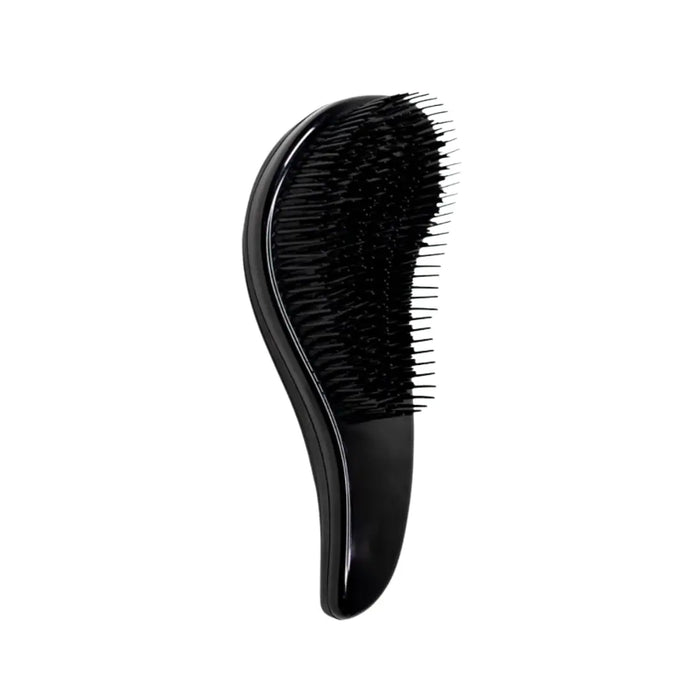
If you prefer a brush to a comb, a flexible-bristle detangler such as the La Biosthétique Detangling Brush works on the same principle: the bristles are set at varying lengths on a soft pad and bend out of the way under load instead of forcing through. Whichever you choose, the sequence matters more than the tool — our piece on why hair tangles in the first place covers the ends-upward method in detail.
Blow-drying: round brush size and bristle
Round brushes are styling tools, not detangling tools. Hair should already be smooth and knot-free before one goes near it, because a round brush is designed to create tension — and tension on a tangle is how hair snaps.
Two decisions: bristle and barrel size. A mixed-bristle round brush like the Evy Schima Mixed Bristle Round 40mm gives you nylon pins for grip and boar bristle for the polish, which is the combination that produces a smooth finish without needing to go over the same section repeatedly.
For barrel size, the rule of thumb is straightforward: a smaller barrel gives more bend and more volume at the root, a larger barrel gives a softer, straighter finish. Short hair generally suits 25mm to 33mm; shoulder-length and longer suits 40mm and up. If you are choosing one brush for a bob, err smaller; for long hair, err larger. The Evy range runs through the sizes if you want to compare them side by side.
Wet hair versus dry hair
One rule applies to every hair type: wet hair is more vulnerable than dry hair. Water swells the strand and the cuticle lifts, which makes hair more elastic but also easier to over-stretch and break.
That does not mean you should never touch wet hair — for curly and coily hair, wet is the only sensible time to detangle. It means the tool has to change. Wet hair wants wide spacing and flexible bristles. Dry hair, once it is already detangled, can take a denser brush for smoothing and oil distribution.
If you only ever buy two, buy a wide-tooth comb or flexible detangler for wet hair and a cushion or paddle brush for dry. That pair covers most people better than one expensive brush trying to do both jobs.
Three brushing myths worth dropping
"A hundred strokes a night." This is Victorian advice and it has not aged well. Brushing is mechanical friction; more strokes means more friction and more cuticle wear. Brush enough to detangle and distribute oil, then stop.
"Brushing stimulates hair growth." Brushing and scalp massage can feel good and may briefly increase local blood flow, but there is no reliable evidence that either grows hair. Growth is driven by the follicle, and the follicle answers to genetics, hormones, nutrition and health — not to how vigorously you brush.
"Boar bristle undoes damage." Nothing you brush with rebuilds a damaged strand. Boar bristle can make hair look better by smoothing the cuticle and carrying scalp oil along the lengths, which improves shine. That is a cosmetic effect, and a real one, but it is not repair.
When the brush isn't the problem
Changing brushes fixes brush-shaped problems: snagging, static, mid-length breakage, curl definition that disappears. It will not fix everything, and it is worth knowing the difference so you are not spending money on tools when something else is going on.
Book in with a professional, or see a GP or dermatologist, if you notice hair coming out in noticeably larger amounts than usual over several weeks, thinning concentrated at the part or temples, bald or patchy areas, a scalp that is painful, burning, scaly or persistently itchy, or breakage that appears suddenly after a colour or chemical service. None of those are brush problems, and no brush or product will resolve them.
If you would like someone to look at your hair in person and tell you what it actually needs, you can find a HUSL pro near you. A stylist who has the hair in their hands will tell you more in five minutes than any guide can.
Frequently Asked Questions
How often should I replace my hairbrush?
When the bristles start splaying, snapping or losing their tips, or when the cushion no longer springs back. A brush with broken bristle tips has sharp edges that catch the cuticle. Most brushes in regular use last a year or two; round brushes used daily with heat tend to go sooner.
Do I need a different brush for wet hair?
Yes, in most cases. Wet hair stretches and breaks more easily, so it wants wider spacing and more flexible bristles than dry hair does. A wide-tooth comb or a purpose-built detangler is the safer choice in the shower.
Is an expensive brush actually better?
Sometimes, and not linearly. What you tend to pay for is bristle quality, how well the bristles are anchored and how long the brush survives daily use. A well-made brush at around the fifty-dollar mark will out-perform a supermarket brush comfortably; beyond that you are largely paying for materials and finish rather than a further jump in performance.
How do I clean a hairbrush?
Pull the shed hair out weekly with the end of a tail comb. Every month or so, wash the bristles in warm water with a drop of shampoo, rinse, and dry bristles-down on a towel so water does not sit in the cushion. Product residue on bristles transfers straight back onto clean hair.
Can I use one brush for everything?
You can, and plenty of people do. You will get better results and less breakage from two — one flexible tool for wet detangling and one cushion or paddle brush for dry smoothing. That is a smaller spend than most people expect.
Should I brush my hair before washing it?
It helps. Detangling dry hair before it gets wet means fewer knots to fight in the shower, when the hair is at its most fragile. The exception is curly and coily hair, which is generally better left alone until it is wet and conditioned.
For everyday brushing technique — how to hold the section, where to start and how much pressure is too much — read our guide to brushing your hair properly without causing breakage.